
Uranus Image 2026/01/07(UT)
Randy Tatum,Andy Casely
R.Tatum,A.Casely
| Randy Tatum |
[ Randy Tatum,Richmond,VA U.S.A]
| Andy Casely |
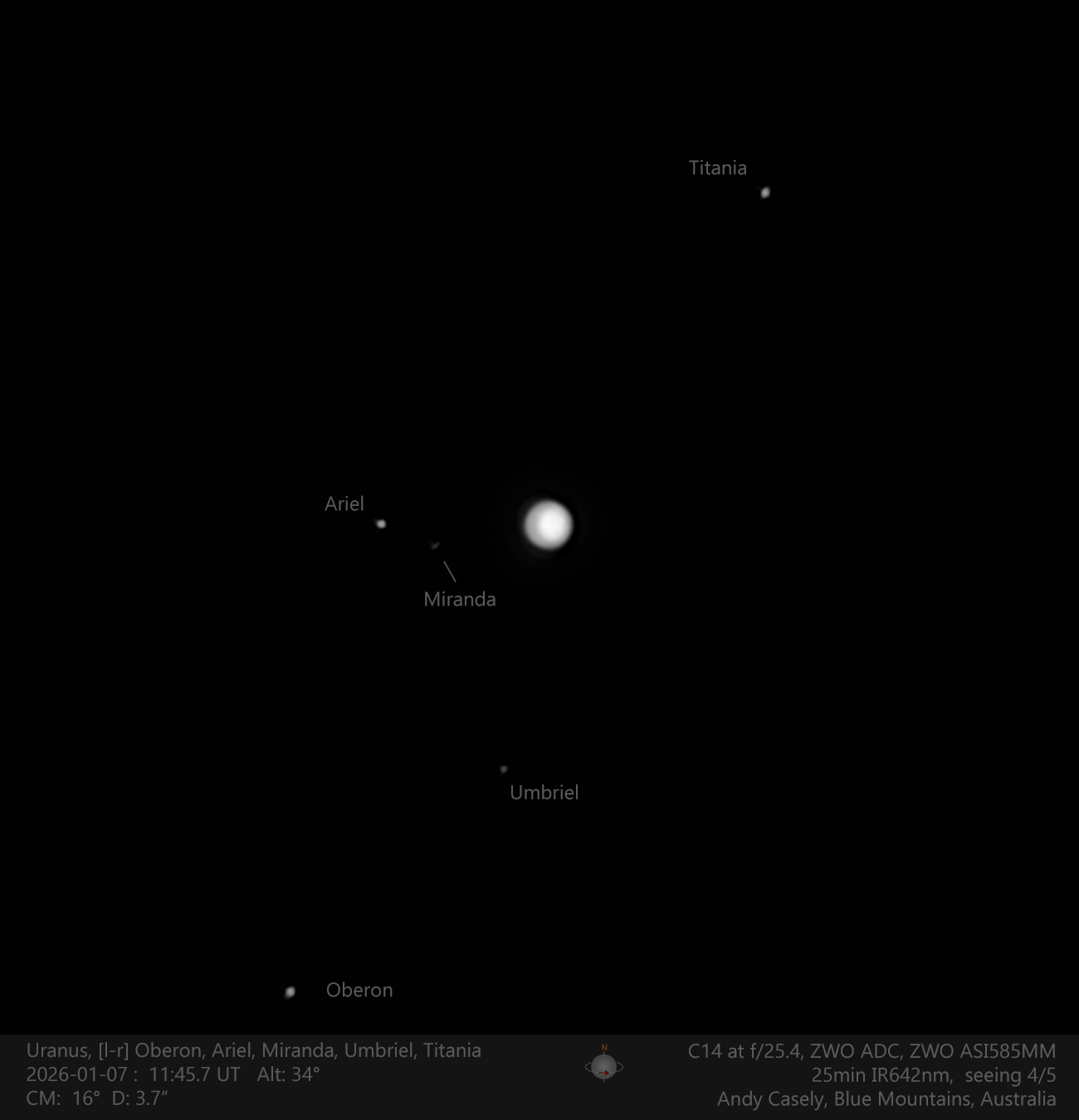
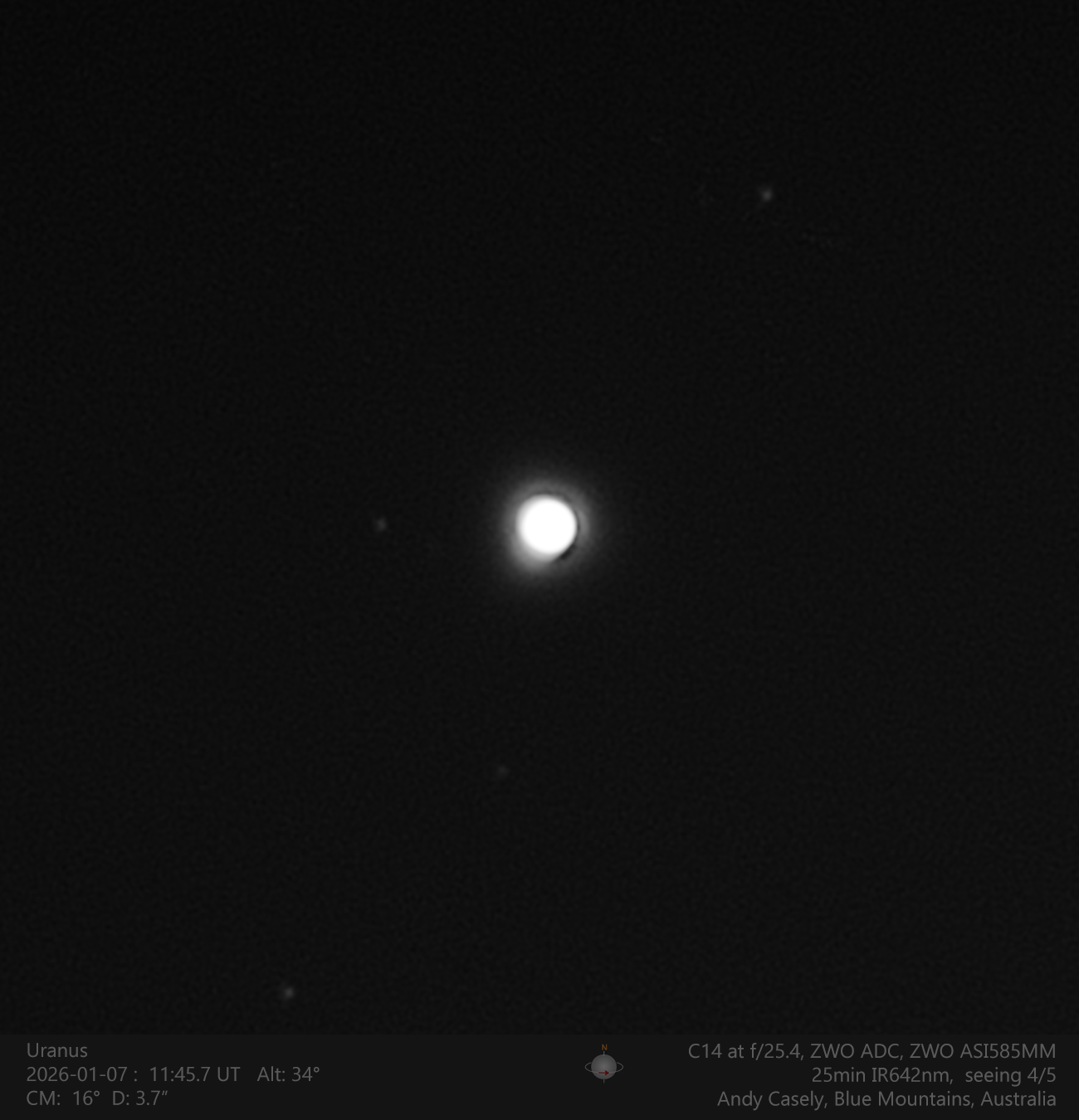
This is the first set of images where there is a chance I have captured the faint rings of Uranus. I'm not certain of the detection, but it's tempting to call it true. Better low-noise cameras like the ZWO ASI585MM mean that it's much easier to see very faint objects close to bright objects, as I saw in 2025 with successful detections of faint Saturn satellites Janus and Epimetheus. The first two images are the stretched versions with and without an overlay to show where the rings should be. The second two images are the "normal" IR642nm combined images of Uranus and moons, with and without labels. Good seeing was enough to bring out Uranus and five satellites quite clearly in infrared (Astronomik IR642nm), all visible in a sequence of captures, with the north pole of the planet bright in IR, slightly offset on the 3.7" disk. On stretching the combined image fairly distinct faint collar appeared around the planet when stretching the image strongly. The rings? It's a bit different from a typical halo fade to black you normally see around a bright object on camera. The stack of 5x5mins is combined in Photoshop from simple sharpened images as WinJupos adds other artefacts that hinder ring detection. In favour of a rings detection is that the fuzz is asymmetrical in exactly the orientation of the predicted ring positions from the NASA PDS Uranus Viewer (Uranus is approaching a solstice where the north pole points almost at Earth) - the 'narrow' polar axis is 10% smaller than the broader equatorial axis, thoguh I wish we were further from Uranus' solstice. The fuzzy halo is close to the correct size and it fades quickly outside the rings, rather than fading smoothly from the planet. It is comparable to some other amateur detections reported. The halo appearance is enhanced by sharpening artefacts on the inside of the halo (not real darkness), but appears best at the 'right' sharpening when the planet is correctly sharpened. Against the detection - the halo is not * precisely* the right size, though it is very close. Collimation is not quite perfect, though focus is OK. I'd need more data in excellent seeing to demonstrate a detection or not I think. Not a Tom Williams image of the rings, but I'm pretty hopeful it's a detection! No obvious features apart from the polar cap on the planet, though seeing was good enough to perhaps show any unusual storms on the planet. Celestron C14, ZWO ASI585MM, ADC, Astronomik IR642nm filter, 25mins.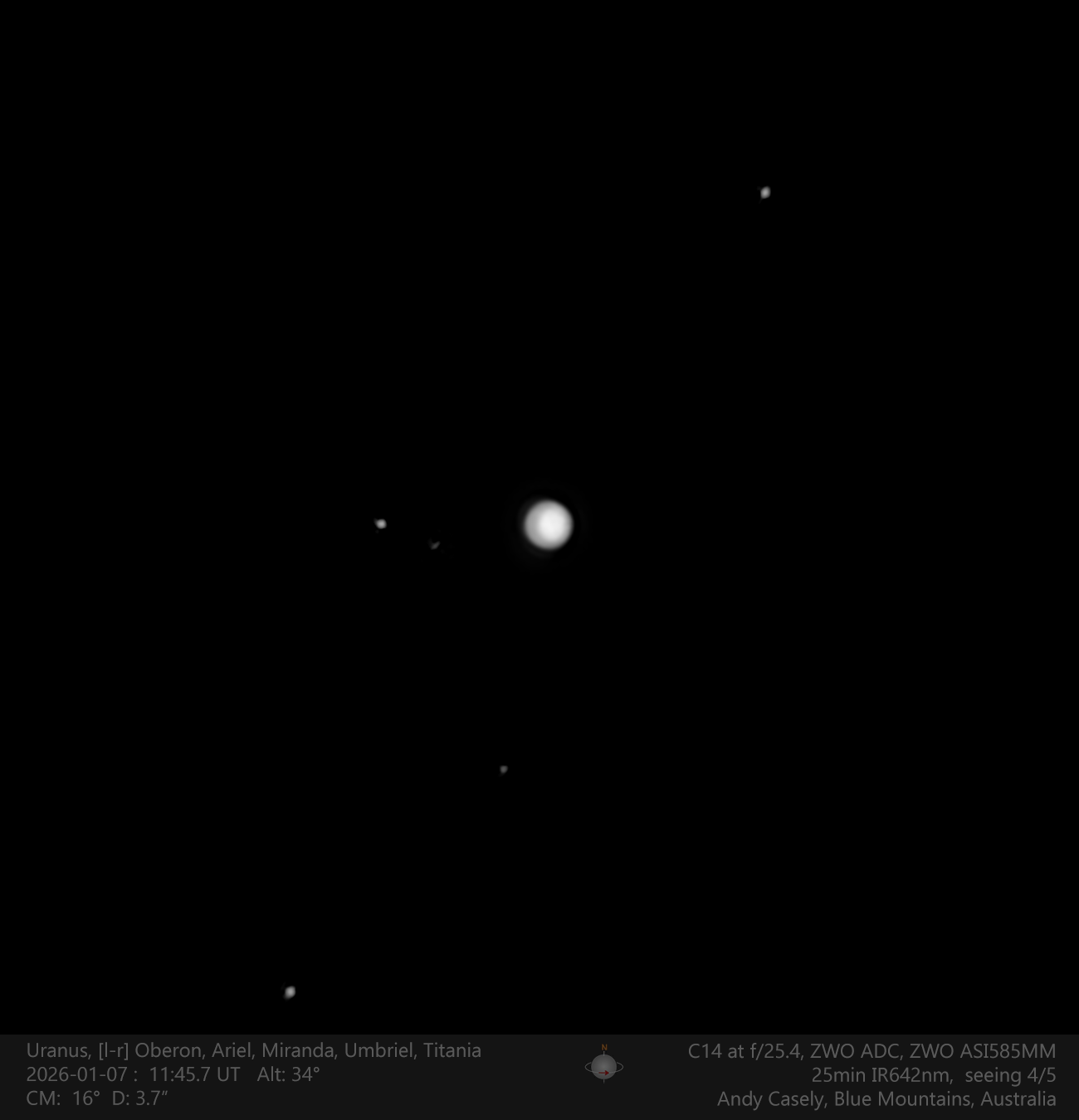
[Andy Casely,Sydney,Australiaa]
 ALPO-Japan Latest ALPO-Japan Latest
 Uranus Section
2026/01/09
| 2025/12/20
| |